
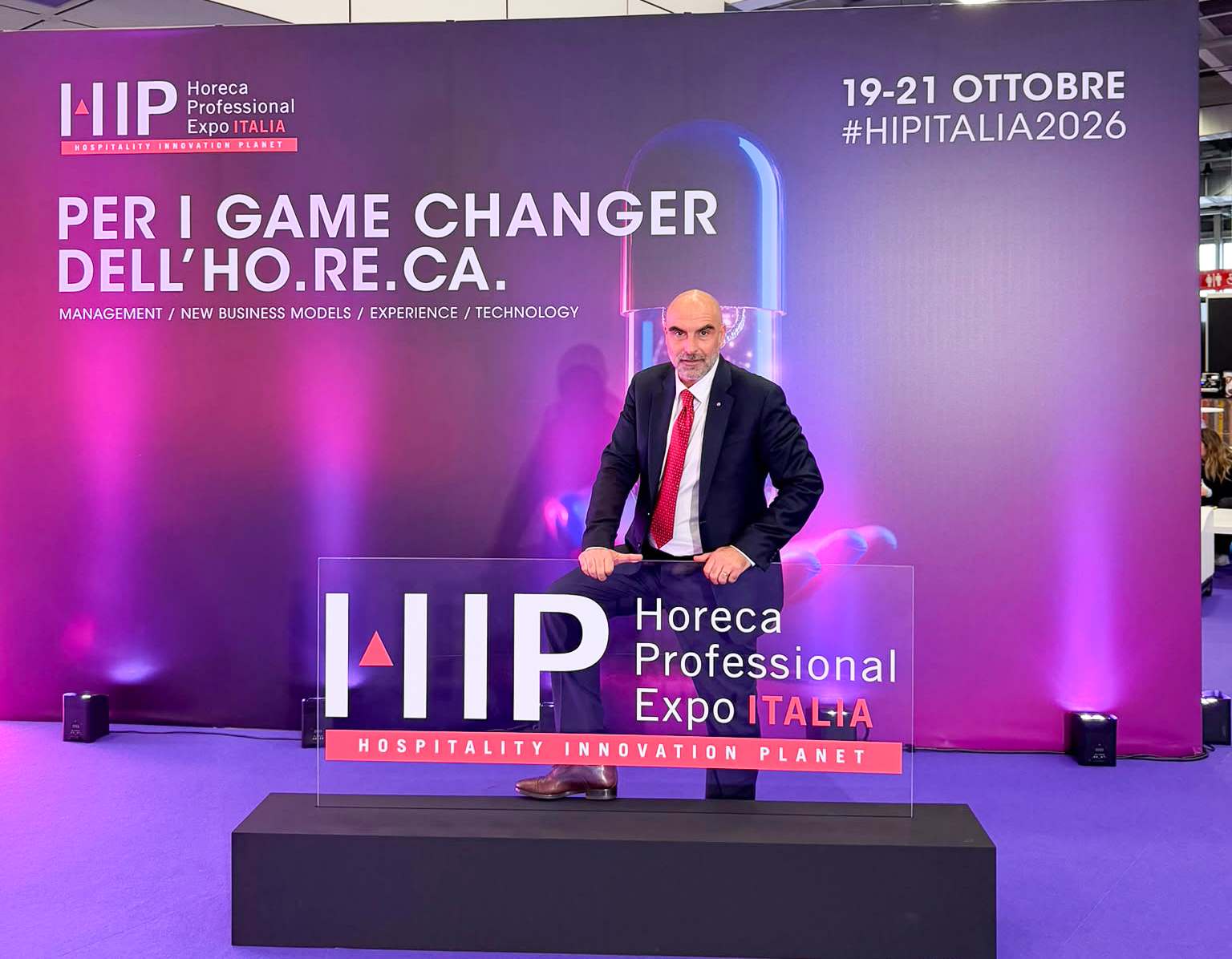
The entrepreneur, business designer and founder of the Poseidonia Hospitality Model took part in the roundtable “More Than Places: When Hospitality Creates Identity, Culture and Community”, which explored how hospitality can drive local development and social cohesion.
Turning a place into a destination means going beyond the quality of its services to create an experience that builds identity, relationships and a sense of belonging. This was the vision presented by Gianni Rizzo, entrepreneur, business designer and founder of the Poseidonia Hospitality Model at Poseidonia Beach Club in Ascea, Cilento, during the roundtable “More Than Places: When Hospitality Creates Identity, Culture and Community”. The event took place at the Digital Theatre in Bologna as part of HIP Italia 2026.
Moderated by Concetta D’Emma, the panel brought together two models of hospitality: the urban model of 21 House of Stories, represented by Francesca Torricella, and the place-based model of Poseidonia Beach Club. These different experiences share a common goal: transforming spaces into places that foster community and belonging. The discussion focused on the role businesses play in enhancing local areas and building connections between economic activities, local communities and visitors.
In this context, Gianni Rizzo shared Poseidonia’s experience, offering a perspective that reaches beyond an individual beach club to address a strategic question for the sector: how can a business grow without losing the identity of the place where it all began?
“I brought an idea of hospitality to the stage, not simply a beach club,” Rizzo explained, summing up an approach that connects business, local territory, culture and community. It is a vision founded on practical principles: standardising processes without making identities uniform, measuring sustainability through verifiable results, incorporating the local area into the offering, and building relationships that go beyond the delivery of a service.
At Poseidonia Beach Club, this approach translates into measurable action: from ISO 20121:2024 certification for sustainable event management, to a 29 kW photovoltaic system producing approximately 26,000 kWh per year, and certification of the claim “Reduced-Waste Menu and Circular Cuisine”, focused on measuring and reducing food waste.
At the heart of the model is the concept of a creative milieu: an environment where people, culture, business and the local area interact to create new value. This is the foundation of the Poseidonia Hospitality Model, a method that brings together the guest experience, food, community, sustainability, service culture and local identity.
The aim is not to replicate a beach club, but to share an organisational and cultural model that can adapt to different settings. In Gianni Rizzo’s vision, growth does not mean creating a chain of identical venues. It means building an “archipelago of places”: distinct destinations rooted in their own local areas and connected by a shared vision of hospitality.
Within this framework, sustainability plays a central role in business decisions. Relationships with the community, protection of environmental resources and the enhancement of local characteristics all become essential to developing an offering that is distinctive and enduring. Hospitality can therefore also drive cultural and social development, strengthening a destination’s position and helping create shared value.
Participation in HIP Italia 2026 is part of Poseidonia Beach Club’s ongoing commitment to developing a responsible model of hospitality, where innovation, environmental awareness and ties to Cilento come together to shape the guest experience. The aim is to share a method and the expertise behind it while respecting the unique qualities of every place where it is applied.
“A place truly becomes a destination when it begins to create a sense of belonging.” With these words, Gianni Rizzo sums up the principle behind his vision: an invitation to rethink growth in hospitality—not as the simple multiplication of venues, but as the ability to create value while maintaining a strong connection between business, local territory and community.